
🔍 Why Privacy Is the Missing Layer in Payments
For years, the blockchain world celebrated transparency , every transaction, every token movement, every smart contract visible on-chain.
But as adoption grows, transparency without privacy becomes a double-edged sword.
In traditional finance, confidentiality isn’t optional, it’s a trust layer. Yet in Web3, your entire transaction history can be traced with a few clicks.
Ethereum, long known for programmability and decentralization, now faces its next frontier: privacy.
And that’s where Kohaku, the Ethereum Foundation’s new wallet initiative, enters the picture.
🧩 What Is Kohaku?
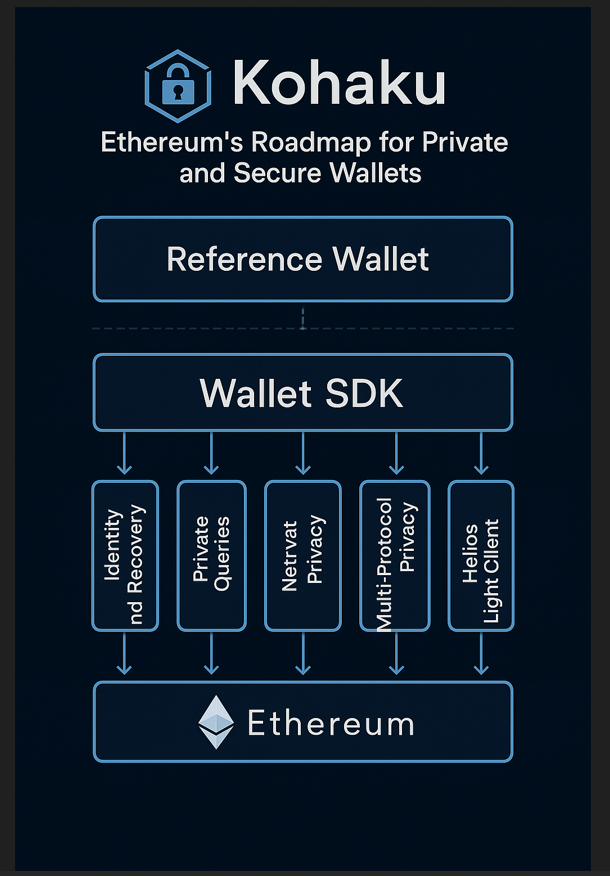
Kohaku is an open-source wallet SDK and reference implementation designed to make privacy the default, not an afterthought.
It allows developers to build private-by-design wallets that shield user metadata, anonymize interactions, and verify blockchain data locally, all without relying on centralized RPC endpoints.
Think of it as Ethereum’s answer to the “financial privacy paradox” balancing user protection with compliance and transparency.
⚙️ How Kohaku Works. The Three Pillars
- 🧱 Privacy SDK
A modular suite of tools for zero-knowledge proofs, light-client verification, and traffic obfuscation. Developers can integrate these features incrementally, no full rebuild required. - 🪙 Reference Wallet
A working demo (built with Ambire and Railgun) showing how per-dApp addresses, shielded transactions, and peer-to-peer broadcasting can coexist with usability. - 🌐 Ecosystem Collaboration
Kohaku’s design encourages wallet teams, RPC providers, and dApp developers to standardize privacy at every layer of the stack.
🏦 Why It Matters for Payments and Stablecoins
Privacy isn’t just a blockchain concern, it’s a financial necessity.
In payments and stablecoin ecosystems, Kohaku’s architecture enables:
- Confidential merchant flows: Transaction metadata (like supplier info or invoice IDs) can stay private.
- Secure consumer wallets: Stablecoin holders can transact without revealing full wallet activity.
- Regulated privacy: Compliance teams can verify identity proofs through zero-knowledge credentials instead of raw KYC data.
This shifts blockchain payments from being “public finance” to personalized, permissioned, and privacy safe finance.
📆 Kohaku’s Three-Phase Roadmap (2025–2026)
| Phase | Focus | Key Capabilities |
|---|---|---|
| Phase 1 (2025) | Local verification & private queries | Remove centralized RPCs and metadata leaks |
| Phase 2 (2025–26) | Shielded transactions & per-dApp isolation | Enable true peer-to-peer broadcasting and privacy layering |
| Phase 3 (2026 +) | Protocol-level privacy | Account abstraction, ZK recovery, post-quantum signatures |
By sequencing features, Kohaku gives developers a clear pathway from today’s wallets to tomorrow’s private payment ecosystems.
🧠 How It Changes Web3 Payments
Today, most Web3 users unknowingly use one address for everything — DeFi, NFTs, stablecoin transfers.
That’s like using the same credit card for your salary account, Netflix subscription, and business expenses.
Kohaku flips this model:
- One wallet → multiple identities
- One address per dApp → no cross-tracking
- One identity breach → no global exposure
For stablecoin and payment gateway developers, this means:
- On-chain analytics can’t easily link wallets across applications.
- Merchants and consumers gain contextual privacy.
- Payments remain compliant while preserving autonomy.
In short, Kohaku allows digital money to behave more like real-world cash , private, portable, and programmable.
🧮 The Real-World Trade-Offs
Implementing privacy has costs:
- Zero-knowledge proofs demand computation power.
- Light clients require local data storage.
- Testing grows complex as privacy adds new edge cases.
But Kohaku’s modular adoption makes this manageable.
Start small with local validation, then roll out per-app accounts, and finally adopt shielded transactions.
Privacy in payments doesn’t have to be all-or-nothing, it can evolve progressively.
💡 When Privacy Improves UX
Ironically, better privacy often improves user experience:
- Fewer phishing attacks when data isn’t visible.
- Simplified onboarding when users don’t expose wallet history.
- Seamless approvals since wallets verify blockchain state locally.
By embedding privacy, Ethereum becomes more human-centric, closer to how people already expect financial systems to behave.
🧭 What’s Next for Ethereum and Digital Payments
Kohaku marks the start of Ethereum’s privacy-native era.
As stablecoins grow to trillions in transaction volume, this framework ensures that the next generation of digital payments is not just transparent but trustworthy.
In 2026 and beyond, expect wallet providers to adopt Kohaku’s SDK, banks to pilot privacy-preserving stablecoin rails, and regulators to recognize programmable privacy as a cornerstone of financial infrastructure.
When transparency meets confidentiality, blockchain payments mature into real payments.
As digital payments move into the Web3 era, privacy won’t be a feature, it will be the foundation. Kohaku could become for Ethereum what HTTPS became for the internet: an invisible standard that makes trust scalable.
🧭 Final Thoughts
Kohaku isn’t just another technical upgrade, it’s Ethereum’s statement of intent. It tells the world that privacy, not speed or scale, will define the next era of digital money. For stablecoins, wallets, and payment ecosystems, this is a turning point. When privacy becomes programmable, trust becomes frictionless. The next leap in payments won’t come from faster rails, it will come from smarter privacy. Kohaku is Ethereum remembering what finance was always meant to be: private, secure, and personal.
