

✨ Introduction: Ethereum Is Not a Cryptocurrency, It’s a Financial OS
We’re at the intersection of programmable money and decentralized infrastructure. While Bitcoin pioneered digital gold, Ethereum took it a step further: it built a decentralized computer that can encode and execute agreements without intermediaries.
In this blog, I’ll take you into Ethereum’s architecture, how the Ethereum Virtual Machine (EVM) works, gas mechanics, smart contracts, consensus evolution, and real-world product implications all from a fintech and product lens.
🔹 Chapter 1: Ethereum as a State Machine
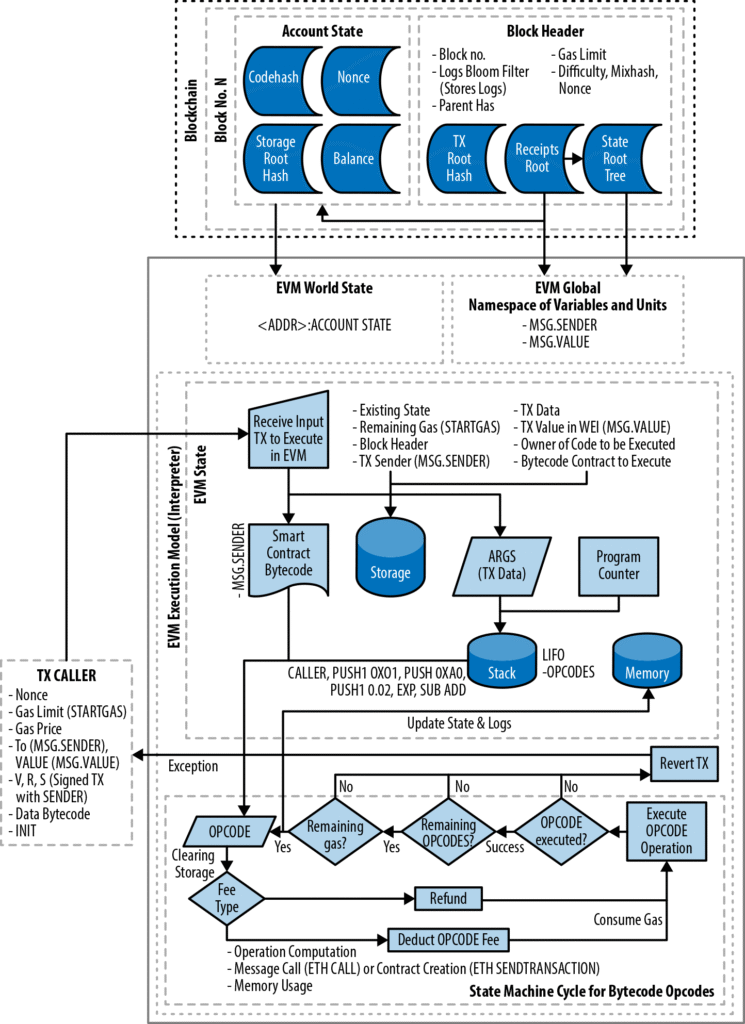
Ethereum’s true nature is not just a blockchain ledger; it’s a state machine. Every block contains transactions that mutate this state. State refers to:
- Balances of all accounts (ETH holdings)
- Smart contract storage values
- Nonces, code, etc.
The Ethereum network begins at a “genesis state”. With each block added, the EVM transitions this state forward, deterministically.
Key Concept: Ethereum can be mathematically represented as: S(N)=σ(S(N−1),T(N))S(N) = σ(S(N-1), T(N))
Where:
S= StateT= Set of transactionsσ= State transition function
🚀 Chapter 2: Ethereum Virtual Machine (EVM)
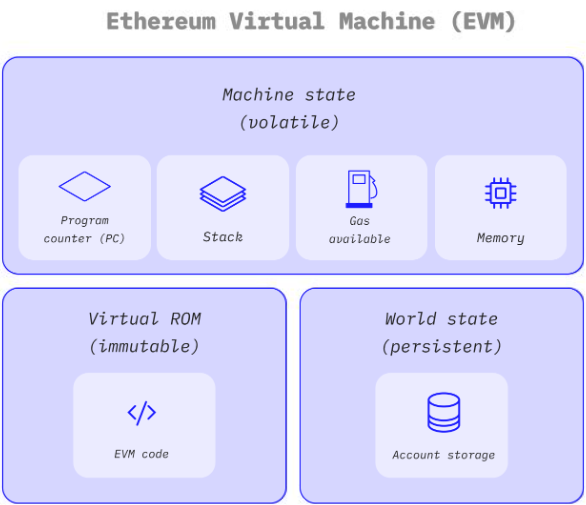
The EVM is a quasi-Turing complete virtual machine that every Ethereum node runs. It’s responsible for executing bytecode derived from Solidity or Vyper source code.
EVM Components:
- Stack: 1024-element LIFO stack (256-bit words)
- Memory: Ephemeral byte-array, cleared every transaction
- Storage: Persistent key-value store, per contract
- Program Counter (PC): Instruction pointer
- Gas Meter: Tracks resource usage to prevent abuse
All computation in Ethereum happens within these constraints.
Bytecode & Opcodes:
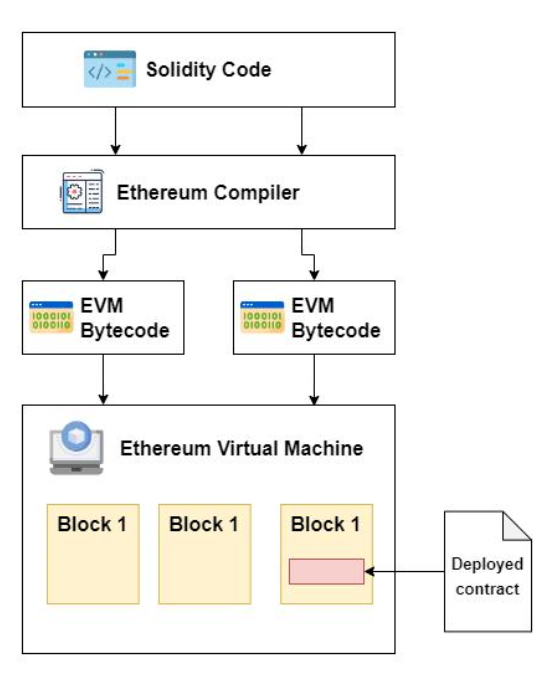
Smart contracts are deployed in EVM bytecode, made up of opcodes like ADD, PUSH, SSTORE, CALL. Each opcode consumes gas.
Example:
function add(uint a, uint b) public pure returns (uint) {
  return a + b;
}
Compiles to:
PUSH1 0x80
PUSH1 0x40
MSTORE
...
ADD
⚡ Product Insight: Treat EVM like a microprocessor for financial logic. Efficiency matters — poorly optimized smart contracts can bankrupt users via high gas costs.
⚖️ Chapter 3: Gas and the Economics of Compute
Ethereum uses gas to meter computation. This prevents denial-of-service attacks and encourages efficient contract design.
How It Works:
- Each opcode has a gas cost (e.g.,
ADD = 3 gas,SSTORE = 20,000 gas) - Users set:
Gas Limit: max units to consumeGas Price: ETH per unit
- Total Fee =
Gas Used x Gas Price
If gas runs out mid-execution, all changes are reverted, but gas is still spent.
🔹 Advanced Tip: Design contracts that minimize
SSTOREoperations and favorMEMORYusage.
📄 Chapter 4: Ethereum Accounts and Transactions
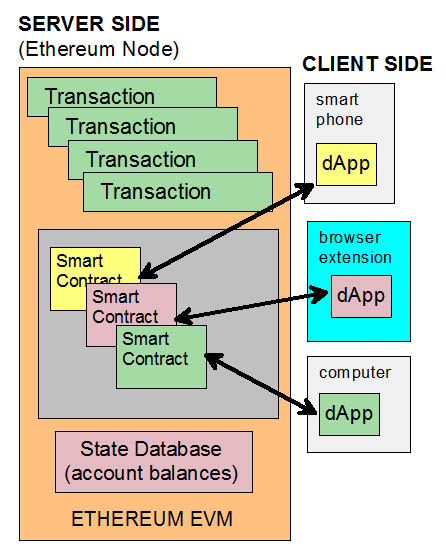
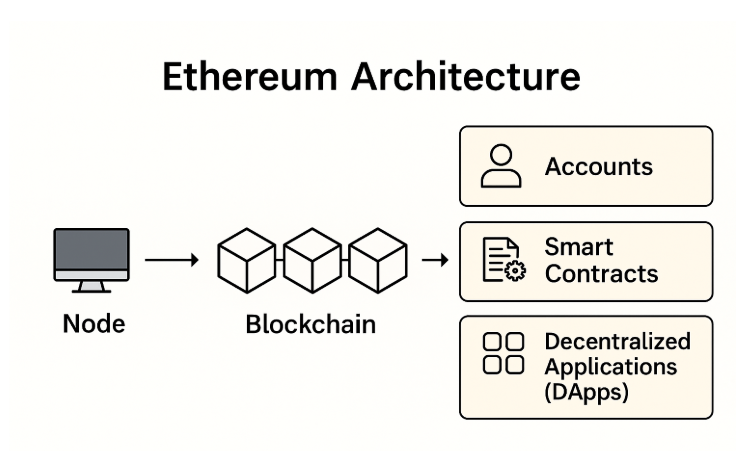
Ethereum supports two account types:
- EOA (Externally Owned Account): Controlled via private keys
- Contract Account: Controlled via code
Transaction Structure:
- Nonce
- Gas Price
- Gas Limit
- To (address)
- Value (ETH)
- Data (payload)
- v, r, s (signature components)
Transactions can:
- Send ETH (EOA ➞ EOA)
- Trigger smart contracts (EOA ➞ Contract)
- Invoke nested logic (Contract ➞ Contract)
🔑 Chapter 5: Smart Contracts in Detail
Smart contracts are self-executing programs. Once deployed, they are immutable.
Contract Lifecycle:
- Write in Solidity
- Compile into bytecode
- Deploy via transaction (creates a new address)
- Interact via function calls and ABI (Application Binary Interface)
Contracts can hold ETH, make calls to other contracts, store complex data structures, and emit logs.
🔹 PM Note: You must consider upgradability patterns (proxy pattern, eternal storage) before deploying in production.
⚠️ Chapter 6: Security, Immutability, and Audit Risks
Bugs in smart contracts are fatal. Unlike traditional systems, there’s no rollback.
Examples:
- DAO Hack (2016): $60M lost due to recursive call vulnerability
- Parity Multisig Freeze (2017): >$150M locked permanently
Common Vulnerabilities:
- Re-entrancy
- Integer overflows
- Unchecked external calls
- Gas griefing
Use tools like:
- OpenZeppelin libraries
- Slither (static analyzer)
- MythX or Certora (formal verification)
⚡ Rule: Audit before launch. Always.
🌐 Chapter 7: From PoW to PoS — Ethereum’s Consensus Shift
Proof of Work (Pre-Merge):
- Miners solved computational puzzles (Ethash)
- Energy-intensive
Proof of Stake (Post-Merge):
- Validators stake 32 ETH
- Chosen pseudo-randomly to propose/validate blocks
- Misbehaviors = slashed stake
Benefits:
- 99.95% energy reduction
- Enables sharding
- Faster finality (12s block time)
📊 Chapter 8: Ethereum in Real-World Fintech
What You Can Build:
- Cross-border stablecoin rails (USDC, EUROC)
- Decentralized FX (Uniswap + Chainlink oracles)
- On-chain lending (Aave-style)
- Tokenized bonds & cash flow structures
- CBDC simulators for sandboxing monetary policy
🧹 Product Angle: Ethereum is a programmable settlement engine. The logic is on-chain, but the UX must be abstracted for mass adoption.
📊 Chapter 9: EVM Compatibility and Layer 2s
Ethereum’s greatest power is its composability.
- Polygon, Optimism, Arbitrum, Base: All run EVM-compatible environments
- You can deploy the same Solidity code across all
Benefits:
- Lower fees
- Higher throughput
- Seamless migration
🔹 Strategy Tip: Build your core contracts to be L2-ready from Day 1. Use libraries like Hardhat/Foundry for deployment automation.
🌍 Chapter 10: Developer Tooling & Workflow
Must-know stack:
- Solidity — Contract logic
- Hardhat/Foundry — Testing, deployment
- Ethers.js/Web3.js — JS SDK for frontend
- IPFS — Decentralized file hosting
- Chainlink — Oracle infrastructure
- The Graph — Indexing and querying
📢 Conclusion: Ethereum as a Financial OS
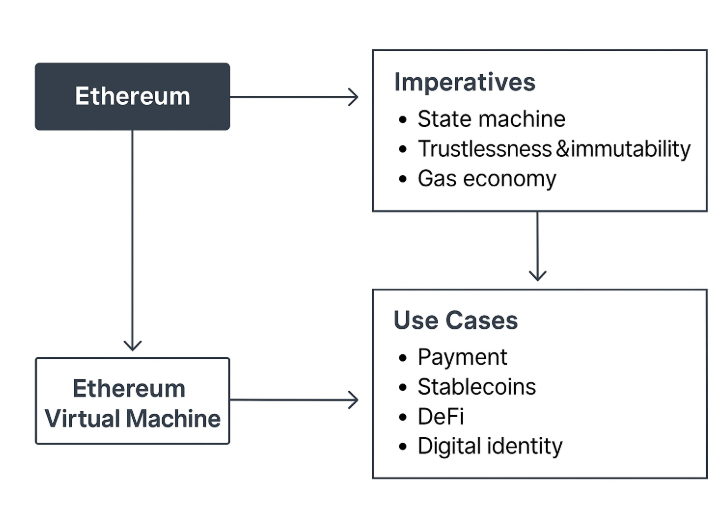
Ethereum is more than a blockchain. It’s a foundational computing layer for the next generation of finance. It allows you to encode rules, automate trust, and rethink global transactions.
But this power demands deep understanding. As product leaders, we must know the internals gas, bytecode, consensus, and state before pushing real assets through smart contracts.
✅ Coming Up Next: “Layer 2s Explained for Product Managers” and “Design Patterns for Upgradable Smart Contracts”.
