

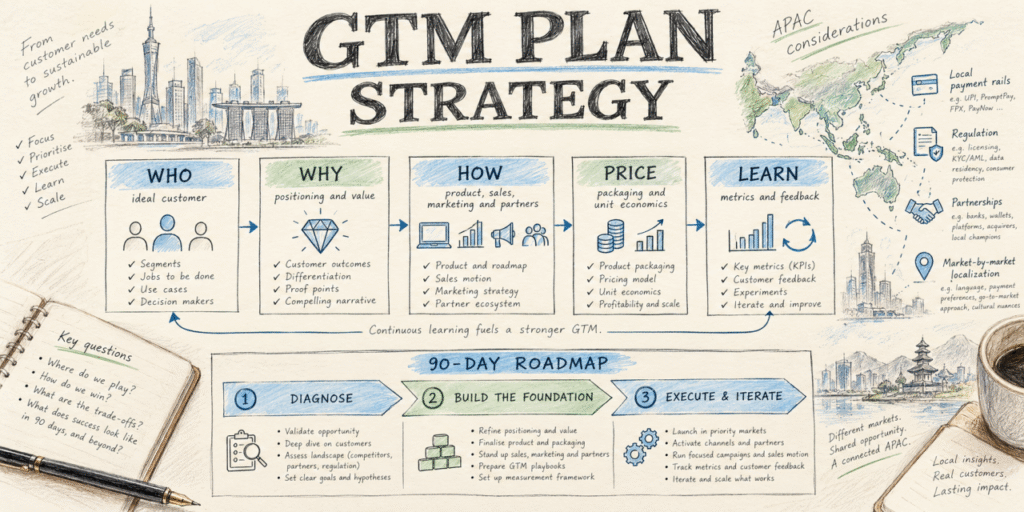
Most people think go-to-market is a launch. A date on a calendar, a press release, a landing page, a flurry of LinkedIn posts, and then everyone exhales and waits for the pipeline to fill.
That belief has killed more good products than bad engineering ever will.
I’ve spent two decades building and shipping products in fintech and payments across Asia, and if there’s one pattern I’ve watched repeat itself, it’s this: brilliant products die from weak go-to-market, and ordinary products win because the go-to-market was tight, deliberate, and treated as a living system. GTM is not the moment you go live. It’s the machine that connects who you sell to, what you say, how you price, where you reach people, how you convert them, and how you keep and grow them all working together, all instrumented, all constantly tuned.
This is the playbook I wish someone had handed me earlier. It’s opinionated, it’s built from scars, and if you apply even half of it seriously, your next launch will look nothing like your last one.
Let’s go deep.
First, Kill the Myth
A launch is an event. Go-to-market is a system.
When you treat GTM as an event, everything gets compressed into a single spike of activity and the moment the spike passes, momentum collapses because there was never an engine underneath it. When you treat GTM as a system, the launch is simply the day you turn the engine on. The engine keeps running, keeps compounding, and keeps getting better because you’ve built the feedback loops to improve it.
Here’s the mental model I use. A go-to-market system has five interlocking parts:
- Who — your Ideal Customer Profile and the buying committee inside it
- Why — your positioning and the value you create versus the alternatives
- How — your go-to-market motion (the mechanism by which you actually acquire customers)
- What it costs and returns — your pricing, packaging, and unit economics
- How you learn — your metrics and operating cadence
Get these five right, in this order, and the launch takes care of itself. Get them wrong, and no amount of launch-day noise will save you. Most teams start at the launch and work backwards. Do the opposite.
Part 1: Who : Get Obsessive About Your ICP
The single most expensive mistake in go-to-market is trying to sell to everyone. It feels safe — a bigger market, more prospects, more optionality. In reality it’s the fastest route to diffuse messaging, long sales cycles, low win rates, and a product roadmap pulled in ten directions by customers who were never a good fit.
Your Ideal Customer Profile (ICP) is not a demographic. It’s the precise description of the customer who gets the most value from what you do, is the easiest to reach and close, and stays the longest. A real ICP has three layers:
- Firmographic: industry, company size, geography, tech stack, business model. In payments, “mid-market e-commerce merchants in Southeast Asia processing cross-border volume” is a starting point, not the answer.
- Behavioral: what are they already doing that signals need? A merchant expanding into a new market, a company that just raised funding, a business hitting the limits of its current provider. Behavior is where the real signal lives.
- The pain intensity: how badly does this hurt, and how urgently do they need it solved? A vitamin gets deprioritized. A painkiller gets budget.
Then, critically, you have to map the buying committee. This is where most first-time GTM efforts fall apart, especially in B2B and especially in enterprise. You are almost never selling to one person. In a typical enterprise deal you’ll find an economic buyer (holds the budget), a champion (wants this to happen and will fight for it internally), users (who live with the product daily), a technical evaluator (integration, security, architecture), and increasingly procurement, legal, risk, and compliance the functions that can’t say yes but can absolutely say no.
I’ve seen deals that were “closed” in the champion’s mind die silently in a procurement queue or a risk review nobody planned for. In regulated industries like payments and financial services, this is the norm, not the exception. If your GTM plan doesn’t have a strategy for every seat at that table, you don’t have a GTM plan you have a hopeful conversation with one enthusiastic person.
The exercise that changes everything: go and interview ten of your best customers and ten deals you lost. Ask the won customers why they bought, what nearly stopped them, and what they’d do without you. Ask the lost deals what they chose instead and why. You will hear your real positioning and your real ICP in their words, not yours. Do this before you write a single line of marketing copy.
Part 2: Why: Positioning Is a Choice, Not a Tagline
Positioning is the most under-appreciated lever in go-to-market, because people confuse it with messaging. Messaging is the words. Positioning is the strategic decision about the context in which your product should be understood and it determines whether your words ever land.
The framework I keep coming back to (I’ll paraphrase it in my own terms) runs like this:
- What are the real alternatives? If your product didn’t exist, what would the customer do? The honest answer is often “a spreadsheet,” “an internal team,” or “nothing” — not your named competitor.
- What can you uniquely do that those alternatives can’t?
- What value does that unique capability deliver in outcomes the customer actually cares about, not features?
- Who cares the most about that value? That’s your best-fit segment.
- What market frame makes your value obvious? The category you choose to compete in changes everything about how you’re perceived and priced.
Let me make this concrete. Imagine two identical payment-orchestration products. One positions itself as “a payment gateway” instantly commoditized, compared on price against a dozen others, a race to the bottom on take rate. The other positions itself as “revenue optimization infrastructure that recovers failed transactions and lifts authorization rates” now it’s compared against lost revenue, and a 1% lift in authorization on large volume is worth far more than any pricing difference. Same product. Radically different position. Radically different willingness to pay.
That’s the power of positioning: it decides who you’re compared to and what you’re worth. Choose it deliberately.
The output of your positioning work should be a crisp, boring, internal document — not clever copy. Something like: For [ICP], who struggle with [problem], [product] is a [category] that [key value], unlike [alternative], because [unique capability]. Ugly on purpose. Once that’s locked, the beautiful copy writes itself, and more importantly everyone in sales, marketing, and product tells the same story.
Part 3: How : Choose Your GTM Motion (and Know Why)
The go-to-market motion is the actual mechanism by which you acquire and grow customers. Choosing the wrong one is like fitting a diesel engine into a race car — the parts are fine, the combination is fatal. Here are the main motions and, more importantly, when each one is right.
| Motion | How it works | Right when… | Watch the metric |
| Product-led (PLG) | User self-serves, activates, expands; free trial or freemium | Low friction, fast time-to-value, individual/team can adopt without permission | Activation rate, product-qualified leads, net revenue retention |
| Sales-led | Outbound/inbound → SDR → AE → demo → POC → close | High deal value, complex buying committee, regulated, integration-heavy | Pipeline coverage, win rate, sales cycle length |
| Marketing-led (inbound) | Content and demand gen fill the funnel | Broad audience actively searching for a solution | Cost per lead, MQL→SQL conversion |
| Channel / partner-led | Resellers, system integrators, platforms, embedded distribution | You need reach you can’t build directly; buyers already trust an intermediary | Partner-sourced pipeline, margin share |
| Community / developer-led | Docs, DevRel, open source, developer advocacy | Your users are builders who evaluate by trying, not by demos | Adoption, time-to-first-integration |
A few hard-won truths about motions.
First, the motion must match the price. This is the rule people violate most often. If your product costs $20 a month, you cannot afford a field sales team with SDRs and AEs — the economics collapse instantly. That product needs to sell itself (PLG). Conversely, if you’re selling a $500,000 platform to a bank, self-serve is a fantasy that buyer needs a relationship, a proof of concept, a security review, and a human who can navigate their organization. Map your motion to your average contract value before anything else.
Second, most successful companies are hybrid and evolve. The most powerful pattern I’ve watched in the last decade is product-led sales: bottom-up adoption creates organic usage inside an organization, and then a sales team layers on top to convert that grassroots traction into enterprise contracts. The developer-first companies in payments and infrastructure are the masters of this — get an individual engineer to integrate in an afternoon, then have a sales team arrive once usage is already business-critical. The product does the top of the funnel; humans close the expansion.
Third, in APAC, channel and partnerships are not optional they are frequently the whole game. I’ll come back to this, because it’s where I’ve spent much of my career and where most imported playbooks break.
Part 4: Pricing and Packaging : The Lever Everyone Ignores
Pricing is the most powerful and most neglected instrument in go-to-market. A pricing change flows straight to the bottom line with no cost of delivery, yet most teams spend months on a logo and an afternoon on their pricing model. It’s backwards.
Two principles matter above all.
Align your price to a value metric. The best pricing scales with the value the customer receives. If they get twice the value, they pay roughly twice as much willingly, because it feels fair. In payments this is almost natural: you charge on volume or on transactions, so cost tracks value and expansion is automatic as the customer grows. In SaaS, the value metric might be seats, usage, records, or outcomes. Pick the metric that most closely mirrors the value delivered, and expansion revenue becomes something you earn quietly every month rather than something you have to fight for at every renewal.
Underpricing is more dangerous than overpricing. New teams almost always price too low, out of fear. But a low price signals low value, attracts your worst-fit and most price-sensitive customers, and starves you of the margin you need to invest in the very things support, product, sales that would let you charge more. Price is a positioning statement. If you’re the premium, outcome-driving solution, your price should say so.
On packaging, the reliable structure is good-better-best a tiered offering that lets customers self-select by need and budget, gives your sales team room to negotiate up, and creates a natural expansion path. Anchor with a strong middle tier (that’s where you want most customers to land), make the top tier aspirational, and use the entry tier to lower the barrier to the first “yes.”
And design for land-and-expand. The first contract doesn’t need to be big — it needs to be a beachhead you can grow from. Land with one team, one use case, one region; then expand across the organization as trust compounds. The companies with the best net revenue retention aren’t necessarily winning more logos — they’re growing the ones they have.
Part 5: The Launch Itself: Tiered, Not Big Bang
Now, finally, the launch and notice how much had to happen before we got here.
Forget the big-bang launch. The single most useful reframe is to launch in tiers, treating each phase as a chance to learn before you scale spend and reputation.
- Design-partner / alpha phase. A handful of hand-picked customers who fit your ICP perfectly and are willing to co-build. They get early access and influence; you get brutal, real-world feedback and, if you choose them well, your first reference stories and case studies. This phase is worth more than any focus group.
- Beta / limited availability. A wider but still controlled group. You’re pressure testing onboarding, activation, support load, and the actual sales conversation at slightly larger scale. You’re watching whether people reach value on their own or get stuck — and fixing the friction before it becomes public.
- General availability. Now you open the gates, and you do it with the confidence of a system that’s already been proven at smaller scale, with real testimonials, refined messaging, tested pricing, and a support function that knows what breaks.
The tiered approach does something psychologically important too: it lets you build proof before you need it. By GA, you’re not making claims you’re citing customers.
Part 6: Metrics : Instrument Everything, Worship Nothing
A go-to-market system you can’t measure is just a set of opinions. But metrics are also where teams fool themselves, so let me be precise about which ones matter at which stage.
Acquisition: cost of customer acquisition (CAC), broken down by channel because a blended number hides the truth that one channel is carrying you and another is bleeding you. Watch pipeline coverage (are you generating enough opportunity to hit the number?).
Activation: for any product with a self-serve element, time-to-value and activation rate are the leading indicators of everything downstream. If people don’t reach the “aha” quickly, no amount of top-of-funnel spend will save you you’re pouring water into a leaky bucket.
Revenue and sales efficiency: average contract value, win rate, and sales-cycle length tell you whether the motion is healthy. A lengthening sales cycle is an early warning that your positioning or your ICP has drifted.
Retention and expansion: this is the metric I’d stare at above almost all others — net revenue retention (NRR). It captures whether your existing customers are growing, flat, or shrinking, net of churn. NRR above 100% means your customer base grows even if you never win another logo. It’s the closest thing to a single-number verdict on whether your product delivers durable value.
Efficiency of the whole engine: CAC payback period (how many months to earn back the cost of acquiring a customer) and the ratio of lifetime value to CAC. These tell you whether your growth is fundamentally profitable or a subsidy you can’t sustain.
The discipline that matters most: separate leading indicators (activation, pipeline, engagement — things you can influence now) from lagging indicators (revenue, churn the results that show up later). Manage the leading indicators. The lagging ones are the scoreboard, not the steering wheel.
Part 7: The Failure Modes I’ve Seen Most
Let me save you some pain. Nearly every go-to-market failure I’ve witnessed traces back to one of these:
- Selling to everyone. No ICP, so messaging is generic, cycles are long, and win rates are poor. The fix is discipline: pick a beachhead and dominate it before you expand.
- Feature messaging instead of outcome messaging. “We have X, Y, Z capabilities” instead of “we recover the revenue you’re losing.” Customers don’t buy features; they buy better versions of themselves.
- Motion-price mismatch. Enterprise sales motion on a low-priced product, or self-serve on a complex six-figure sale. The economics never work.
- Underpricing and no value metric. Leaving enormous margin on the table and attracting the wrong customers.
- Launch as event. Everything peaks on day one and collapses on day two because there was no system underneath.
- Sales and marketing misalignment. Marketing celebrates lead volume; sales complains the leads are junk. Without shared definitions and a feedback loop, you get a civil war instead of an engine.
- Ignoring retention. Obsessing over acquisition while customers quietly churn out the back. The leaky bucket. Growth without retention is just expensive treading water.
- Copy-pasting a foreign playbook into a new market. Which brings me to the mistake I care about most.
Part 8: A Use Case Close to Home : Going to Market in APAC
Here’s where I’ll plant my flag, because it’s where I’ve operated and where I’ve seen the most expensive misunderstandings.
Asia-Pacific is not a market. It’s dozens of markets that happen to share a map. A go-to-market strategy that works beautifully in a single homogeneous market often shatters the moment it meets the reality of APAC’s fragmentation different regulators, different payment rails, different languages, different consumer behavior, and radically different levels of digital maturity from one country to the next.
Consider a fintech expanding across Southeast Asia. The payment behavior alone varies enormously market to market different dominant local wallets, different real-time payment rails, different card penetration, different reliance on cash, different QR standards. A checkout experience optimized for one country can convert terribly in the one next door simply because you didn’t offer the local payment method people actually trust. In payments, localization is not translation it’s plumbing.
Then there’s regulation. In financial services, you often cannot even go to market without the right licenses, local entity structures, data-residency compliance, and KYC/AML frameworks tuned to each jurisdiction. The regulatory work is part of the go-to-market plan, not a legal footnote to be handled later. I’ve watched teams build a beautiful product and brilliant marketing, then lose a year because the compliance path in a target market was an afterthought.
And this is precisely why partnerships dominate go-to-market in this region. Trust is often local. A domestic bank, a local platform, a regional e-commerce player, or an established distributor can give you reach and credibility that would take you years and enormous spend to build directly. The right partner shortcuts market entry but the economics (revenue share, margin, control of the customer relationship) have to be modeled carefully, because a partner who owns your customer relationship also owns your leverage.
The practical lesson: enter APAC market by market, not as a bloc. Pick one beachhead market where your ICP is strongest and the regulatory path is clearest. Win it decisively local payment methods, localized product, a credible local partner, compliance sorted. Build the reference stories and the operating know-how. Then replicate the playbook, market by market, adapting each time. The companies that treat “APAC” as a single launch fail. The ones that treat it as a sequence of focused, localized entries win.
Part 9: Your First 90 Days: An Operating Cadence
If you’re stepping into a go-to-market challenge a new product, a new role, a new market here’s how I’d structure the first ninety days.
Days 0–30: Diagnose. Resist the urge to act. Interview customers you’ve won and deals you’ve lost. Audit the current positioning honestly. Baseline every metric that exists (and note the ones that don’t). Sit in on sales calls. Read the support tickets. Your job in month one is to see reality clearly, because most GTM problems are misdiagnosed.
Days 30–60: Fix the foundation. Sharpen the ICP to something uncomfortably specific. Rewrite the positioning as that boring internal document and get product, sales, and marketing to agree on it word for word. Pressure-test pricing and packaging against the value metric. Establish shared definitions between sales and marketing (what is a qualified lead, who owns what, what’s the handoff). Instrument the metrics you were missing.
Days 60–90: Execute and iterate. Turn on the motion. Run a tiered launch if you’re launching. Institute a weekly go-to-market review one standing meeting where sales, marketing, product, and RevOps look at the same leading indicators and decide what to double down on and what to kill. Speed of iteration is your real competitive advantage; the weekly cadence is what turns a static plan into a learning system.
The Meta-Lesson: GTM Is Orchestration
Here’s what I’ve come to believe after all these years. Go-to-market is not a marketing function or a sales function. It is orchestration — the deliberate alignment of product, marketing, sales, pricing, finance, and, in regulated industries, risk and compliance, all pointed at the same customer with the same story.
The best go-to-market leaders I know are translators. They can sit with an engineer and understand what’s genuinely differentiated, sit with a CFO and speak in unit economics, sit with a salesperson and understand why deals stall, and sit with a customer and hear the real problem underneath the stated request. They hold the whole system in their head and keep every part in tune with every other part.
And they run on evidence, not ego. They treat every launch as a hypothesis, every metric as feedback, and every failure as data. They build a culture where “let’s test it and measure” beats “I think” every single time.
If you take one thing from this: stop planning launches, and start building systems. The launch is just the day you switch the machine on. The machine is the strategy.
If this resonated, I write regularly about go-to-market, payments, and building products in Asia. I’d love to hear your own hard-won lessons the failure modes above came from real scars, and I’m always collecting more.

Leave a Reply