

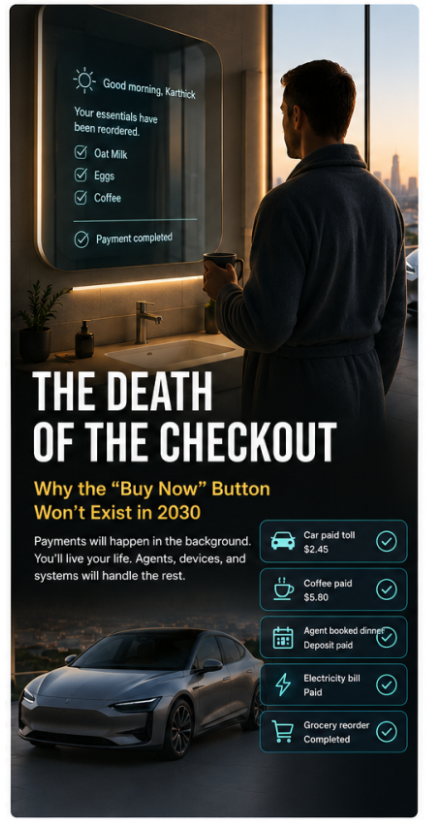
Let me paint a picture of an ordinary morning in 2030.
You wake up. Your smart mirror has noticed your grocery patterns and asks your assistant to reorder oat milk, eggs, and the specific brand of coffee you drink. The order stays within the spending limits you set. A confirmation appears. You never open a checkout page.
You walk to your car. It pulls out of the garage, drives you to work, and pays the expressway toll through the account you previously authorized. The charge appears on your monthly mobility bill.
You stop for coffee. You walk in, pick up your usual order, and leave. The store charges the account linked to your app or device. There is no cashier interaction and no separate payment step.
At work, your agent has booked a client dinner for tomorrow, paid the deposit within an approved mandate, and added the reservation to your calendar. You review the confirmation. You did not approve that exact transaction in real time; you approved the agent’s purpose, limits, and authority three months earlier.
At lunch, you buy a shirt you saw in a social feed. You tap the product. Your identity, address, and payment method are already verified, and the order completes after a low-friction risk check.
You come home. Your electricity, water, and internet bills adjust to usage. Your car recharges and pays the charging provider. Your fridge notices that a few essentials are running low and proposes or places an order according to your preferences. A language-learning subscription adjusts to the plan you use.
At no point during the day did you type a card number, fill out a shipping form, select a payment method, click a “Buy Now” button, or think about the mechanics of payment.
That is what I mean by the death of the checkout. It does not mean every purchase becomes invisible. High-value, emotional, unusual, or regulated transactions will still require deliberate confirmation. But for routine commerce, the checkout is increasingly becoming a background capability rather than a destination.
Most of the building blocks already exist. The open questions are adoption, interoperability, regulation, economics, and trust.
I want to explore how this shift is unfolding, what is driving it, what it means for merchants, and, most importantly, what product managers should be building now.
The Trend Line Nobody Is Talking About Loudly Enough
For most of e-commerce history, the industry has focused on reducing checkout friction: one-click checkout, guest checkout, autofill, digital wallets, stored credentials, and faster authentication. Each innovation removed another field, click, or decision.
We are now approaching the logical endpoint of that trajectory: not necessarily zero interaction, but zero repeated data entry and no separate checkout moment for many low-risk or repeat purchases.
Look at what is already happening in 2026:
- Checkout-free retail technology is operating at hundreds of third-party locations. Amazon’s Just Walk Out technology continues to expand even after Amazon announced that it would close or convert its Amazon Go and Amazon Fresh physical-store formats. The technology and the store format are no longer the same bet.
- Ride-hailing platforms such as Uber normalized the idea that the service ends and payment happens in the background.
- Subscriptions, stored credentials, and connected services have made recurring or usage-based charging familiar to consumers.
- Network tokens and bank-account mandates allow approved merchants and platforms to initiate subsequent transactions without asking customers to re-enter payment details each time.
- Agentic commerce infrastructure is moving from concept to early deployment, with emerging approaches from card networks, technology companies, and payment providers.
Each is a fragment of the same picture. When you assemble the pieces, a coherent shift appears: the checkout event is becoming less visible.
The Three Forces Reducing the Need for Checkout
Three forces are converging. Any one of them would be significant. Together, they could change the way routine commerce works.
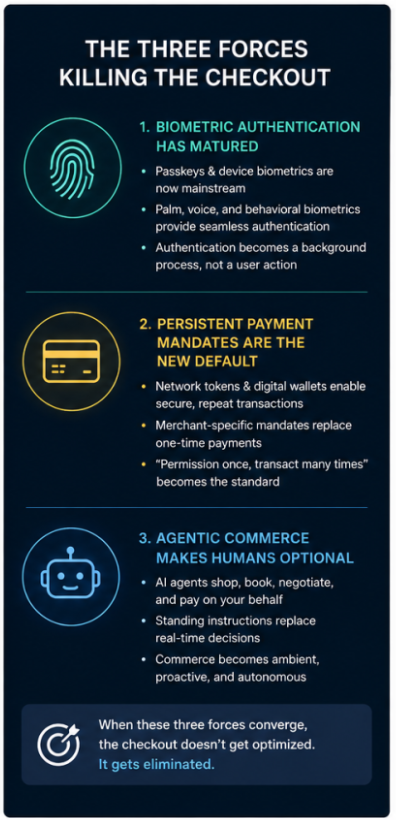
Force 1: Authentication Is Becoming Faster and More Contextual
Passwords are losing ground, and that reduces one of the largest sources of checkout friction: proving that you are really you.
Passkeys are now supported by many major online platforms. The FIDO Alliance’s 2025 Passkey Index, based on nine large implementers including Amazon, Google, Microsoft, PayPal, Target, and TikTok, reported that 93% of eligible accounts could use passkeys, 36% had enrolled one, and 26% of sign-ins were already using them.
Biometrics also extend beyond a single face or fingerprint check. Device signals and behavioral patterns can help systems assess whether a session appears legitimate. These signals are generally better understood as inputs into risk-based authentication, not as universal permission to charge a customer.
It is also important not to confuse technical possibility with durable product adoption. Amazon One was once a prominent example of palm-based payment and identity, but Amazon discontinued the retail service in June 2026. That is a useful warning: a technically elegant authentication method still needs compelling economics, consumer trust, and a sustainable operating model.
The direction of travel remains clear. For many transactions, authentication is becoming less like a separate ceremony and more like an ongoing confidence assessment. Higher-risk activity will still require step-up verification.
Force 2: Standing Permissions Are Replacing Repeated Data Entry
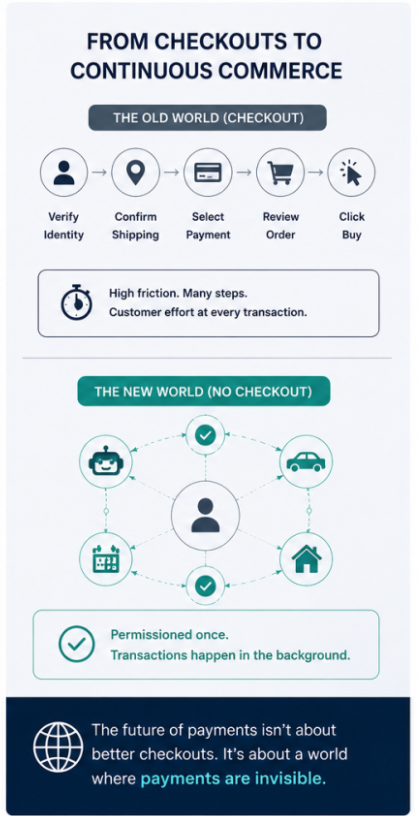
The traditional checkout looks like this:
Verify identity, confirm shipping, select payment, review the order, click “Buy,” and wait for confirmation.
The emerging model is:
Grant a clearly defined permission once, then allow transactions within its limits.
Network tokens and stored credentials let merchants submit subsequent transactions without requiring customers to type card details again. Every transaction still goes through authorization, and additional authentication may be required depending on risk, value, regulation, or issuer policy.
Bank-account mandates are also evolving. In the United Kingdom, Variable Recurring Payments currently support customer-authorized payments within agreed parameters, with mandated use focused on sweeping between a customer’s own accounts and broader commercial use continuing to develop. Other markets have their own recurring-payment and e-mandate frameworks, but they are not all equivalent.
The important product shift is not “charge whenever you want.” It is permission with purpose, amount limits, duration, auditability, and revocation.
The industry is moving toward a model in which customers authorize a merchant, platform, or agent to act within defined boundaries. Individual transactions then occur under that permission rather than restarting the entire checkout flow.
Force 3: Agentic Commerce Is Changing How Intent Is Expressed
If better authentication reduces identity friction and standing permissions reduce payment friction, agentic commerce can reduce the work of searching, comparing, and selecting.
Instead of visiting a checkout page, a customer may describe an outcome: keep household essentials stocked, book a compliant business trip, find a replacement part within a budget, or renew a service only if the price stays below a limit.
Software can then search, compare, recommend, and, where permitted, transact.
This is not the same as giving an agent unlimited authority. Trustworthy agentic commerce requires guardrails: approved merchants, category restrictions, spending limits, expiration dates, escalation rules, receipts, explainability, and immediate revocation.
The infrastructure is developing quickly. Visa’s Trusted Agent Protocol is designed to help merchants distinguish trusted commerce agents from malicious bots. Mastercard is expanding Agent Pay capabilities. Google’s AP2 focuses on payment authorization for agents, while Stripe’s Machine Payments Protocol supports machine-to-machine payments. These approaches are evolving, are not interchangeable, and are not yet universal standards.
In 2024, much of this sounded like marketing language. In 2026, early commercial systems and protocols are appearing. By 2030, agent-mediated purchasing could become meaningful in categories where customer intent is repeatable, constraints are clear, and the cost of a mistake is manageable.
What Checkout-Free Retail, Uber, and Automated Replenishment Have Already Taught Us
Industry shifts are often signaled by experiments that initially look niche. Invisible checkout is no exception.
Checkout-free retail. Amazon Go demonstrated that computer vision, sensors, identity, and payment could remove a traditional checkout line. Amazon later decided to close or convert its Amazon Go and Amazon Fresh physical-store formats, while its Just Walk Out technology continued expanding through third-party locations. The lesson is nuanced: the technology can work even when the original retail format does not scale economically.
Uber. Before ride-hailing apps, paying for a taxi was a separate end-of-journey event. Uber redesigned the experience so the rider arrives, exits, and receives a receipt afterward. The lesson is that customers often value payment disappearing from the main service journey when the amount, provider, and dispute process remain understandable.
Automated replenishment. Voice reordering and connected-device replenishment did not become universal, partly because the interfaces and use cases were limited. But the underlying idea was important: a device or service can detect a recurring need and initiate a purchase within customer-defined rules.
Subscriptions and stored credentials. Consumers have shown that they will allow ongoing charges when the value exchange is clear and controls are accessible. The lesson is not that customers want unlimited merchant authority. It is that they will accept standing relationships when they understand the benefit and can monitor or stop them.
Amazon One. Its discontinuation is another useful lesson. Removing friction is not enough. Products also need trust, habitual use, broad acceptance, manageable costs, and a strong reason to exist alongside simpler alternatives.
The future will not be created by one perfect technology. It will emerge from the combination of identity, permission, risk controls, machine-readable commerce, and customer trust.
A Three-Phase Timeline Through 2030
Here is how I see the shift unfolding. These are my predictions, not established industry forecasts.
Phase 1: The Permission Era, 2026–2027
Stored credentials, tokenized payments, account mandates, and merchant-specific authorizations become easier to grant and manage. More services offer customers a visible way to define limits, review activity, and revoke access.
Passkeys continue to replace passwords across major services, although adoption remains uneven. Biometric and device-based signals increasingly support low-friction authentication, while higher-risk activity triggers step-up checks.
More “no separate checkout” experiences appear for verified customers and repeat purchases. Social, marketplace, and assistant interfaces complete purchases inside the discovery experience, with explicit confirmation when value, risk, or regulation requires it.
My working estimate: By the end of 2027, a substantial share of repeat e-commerce purchases could occur without a separate payment-selection step or a traditional checkout page. That is different from saying that every purchase will be one tap or fully automatic.
Phase 2: The Agentic Era, 2028–2029
AI agents become transaction initiators for a meaningful segment of commerce. The strongest early use cases are likely to be structured and bounded: travel planning, subscription management, household replenishment, procurement, and service coordination.
Permission structures evolve from “authorize this merchant” to “authorize this agent for this purpose, within these limits, for this period.” The agent may then transact with approved merchants while producing a clear audit trail.
Merchants restructure for agent visibility. Product catalogs become machine-readable as well as human-readable. Price, inventory, delivery windows, return policies, restrictions, and product compatibility need to be available through clean data and APIs.
Morgan Stanley has estimated that agentic shoppers could represent $190 billion to $385 billion of U.S. e-commerce spending by 2030, equivalent to roughly 10% to 20% of the market in its scenarios. That is a forecast, not a certainty, but it indicates the scale that serious market participants are considering.
My working estimate: By the end of 2029, agent-initiated activity could account for a high-single-digit to low-teens share of e-commerce spending in leading categories, with much lower adoption elsewhere.
Phase 3: The Ambient Era, 2030 and Beyond
For many routine categories, checkout becomes an exception rather than the default. Groceries, household consumables, transportation, subscriptions, and small services increasingly happen through ongoing permissions, recommendations, and automated execution.
Physical retail continues to adopt checkout-free or line-free experiences in formats where the economics work. Other stores use smart carts, scan-and-go, or app-based payment rather than fully autonomous systems.
Payment remains a deliberate experience for high-value, emotional, unusual, regulated, or difficult-to-reverse purchases: a car, a house, a luxury item, a major trip, or a gift. In those contexts, confirmation is part of the customer’s decision, not merely friction.
My base case: By 2030, more than half of repeat digital purchases could occur without the customer typing a card number, completing a shipping form, or visiting a traditional checkout page. That is a narrower and more defensible claim than saying most consumer purchases will become fully invisible.
Who Wins and Who Faces Pressure
This shift will not be evenly distributed.
Likely Winners
- Large commerce platforms with identity, payments, logistics, and customer data. They can connect discovery, trust, fulfillment, and payment in one experience.
- Payment infrastructure providers. Providers that support tokenization, mandates, agent credentials, fraud controls, orchestration, and dispute management can benefit regardless of which merchant wins the sale.
- Card networks and account-to-account payment operators. They remain important if they evolve from checkout rails into trust, credential, authorization, risk, and dispute layers for automated commerce.
- Assistant and agent platforms. Platforms that mediate customer intent may influence which merchants and products are considered.
- Category-leading brands. Strong brands can become default choices when customers give agents instructions such as “reorder my usual shoes” or “buy the most reliable option.”
Businesses That Face Pressure
- Merchants without structured product data. If an agent cannot understand inventory, price, compatibility, delivery, restrictions, and returns, that merchant may be excluded before a human ever sees the offer.
- Brands with weak differentiation. Agents may compare products more directly on price, quality, availability, delivery, and policy, making vague positioning harder to defend.
- Retailers that depend entirely on visual browsing or checkout-page persuasion. They may lose influence when discovery moves into an agent interface. At the same time, agents could create new forms of algorithmic impulse purchasing, so this will not be a simple end to impulse buying.
- Slow-moving retailers. Long integration cycles and poor data quality will become more damaging as protocols and customer expectations change.
- Checkout-optimization businesses that remain narrowly focused. The opportunity will shift from optimizing fields and buttons to managing identity, consent, risk, permissions, and recovery.
The Privacy and Trust Questions We Cannot Ignore
Invisible checkout requires access to more context: identity, preferences, location, purchase history, budgets, and permissions. That creates genuine value, but it also increases responsibility.
The goal should not be maximum data collection. It should be the minimum data required to complete the customer’s intent safely, with clear boundaries and accountability.
The risks are real:
- A larger blast radius when credentials or permissions are compromised. A stolen standing authorization could enable repeated unauthorized activity until controls detect it or the customer revokes it.
- Conflicts of interest and behavioral manipulation. An agent may be influenced by commissions, preferred merchants, advertising, or ranking rules that are not obvious to the customer.
- Loss of financial awareness. When purchases happen in the background, customers can lose track of cumulative spending even when each individual transaction is valid.
- Regulatory complexity. Different jurisdictions apply different rules to consent, recurring payments, authentication, data use, agent responsibility, refunds, and disputes.
- Disproportionate harm to vulnerable customers. People with limited digital literacy, cognitive impairment, or financial stress may need stronger defaults, simpler controls, and more visible confirmations.
These risks do not necessarily stop the trend. They determine whether customers trust it.
The strongest products will make permission visible, explain why a transaction happened, show who benefited, preserve receipts and evidence, and make cancellation or revocation immediate.
What Product Managers Should Build
If you believe commerce is moving in this direction, here is where I would focus.
For Merchants and Marketplaces
- Rebuild product data for machine consumption as well as human presentation. Provide structured inventory, pricing, compatibility, delivery windows, restrictions, and return policies through reliable APIs.
- Support permission-based commerce. Build flows for granting, reviewing, modifying, pausing, and revoking standing authorizations. Include purpose, amount, frequency, duration, merchant scope, and escalation rules.
- Measure human and agent activity separately. Agents and people browse, compare, convert, return, and dispute differently. Mixing the traffic can corrupt your analytics.
- Experiment with one relevant agentic-commerce approach. Visa Trusted Agent Protocol, Mastercard Agent Pay, Google’s AP2, and Stripe’s MPP address different parts of the problem. Treat them as evolving rather than interchangeable standards.
- Preserve a human path. Customers must always be able to inspect, correct, override, and recover from automated decisions.
For Payment Providers and Fintechs
- Own the permission-management layer. The best experience for viewing and controlling standing authorizations could become as important as the traditional wallet.
- Build fraud detection for permission-based flows. The new question is not only “Is this transaction fraudulent?” It is also “Is this transaction consistent with the customer’s mandate, context, and expected agent behavior?”
- Support cross-rail routing carefully. Cards, real-time bank payments, wallets, and digital assets have different economics, protections, finality, and regulatory obligations. Route based on more than cost and speed.
- Invest in identity, consent evidence, and auditability. When the checkout disappears, the ability to prove who authorized what, under which limits, and when becomes central.
- Redesign disputes and recovery. Customers need clear remedies when an agent acted within technical permission but outside their reasonable expectation.
For Consumer Product Managers
- Treat the permission-granting flow as the new checkout. It deserves the same level of care once given to payment conversion.
- Build transparency by default. Users should be able to ask, “Why did this happen?” and receive a clear answer covering the instruction, merchant, amount, rule, and data used.
- Make cancellation and revocation immediate. A customer should be able to pause an agent, revoke a merchant, reduce a limit, or require confirmation without navigating a maze.
- Protect financial awareness. Use summaries, forecasts, anomaly alerts, and budget views so that low-friction commerce does not become invisible overspending.
- Design stronger safeguards for vulnerable users. Offer conservative defaults, trusted contacts, cooling-off periods, and accessible explanations where appropriate.
For Commerce Infrastructure Teams
- Assume identity and consent are becoming part of the transaction itself. The strategic question shifts from “How do we optimize checkout?” to “How do we verify identity, authority, intent, and limits?”
- Build for continuous risk assessment, not continuous surveillance. Use proportional signals, minimize data, and step up only when the risk justifies it.
- Prepare for new fraud and dispute patterns. Agent impersonation, mandate abuse, prompt manipulation, merchant misrepresentation, and unclear liability will require new controls.
- Design for interoperability and portability. Customers should not be trapped in one agent, wallet, merchant, or permission dashboard.
The Contrarian View: Where This Could Fail
Every product manager should steelman the opposite case.
Consumer trust may not scale. Customers may accept automated replenishment and subscriptions but reject broader authority. Invisible checkout could remain concentrated in a few routine categories.
Regulation may require more explicit consent. A major fraud event or widespread complaints could lead regulators to demand confirmation for more transaction types, limiting ambient execution.
Fragmentation may persist. If every merchant, platform, wallet, and agent uses a different permission model, customers may become confused and return to explicit checkout.
The economics may not work. Amazon One’s discontinuation and Amazon’s decision to close its Go and Fresh store formats show that technically impressive experiences do not automatically produce a scalable business model.
Economic downturns may change behavior. When household budgets tighten, customers often want more visibility and control, not less. Background spending can become a liability.
My rough probability view is still broadly optimistic: a 60% chance that invisible checkout expands substantially in routine digital commerce by 2030, a 25% chance that adoption is meaningful but narrower or slower, and a 15% chance that trust, economics, fragmentation, or regulation keep it at the margins.
Even the slower scenarios represent a major change. This is a shift worth preparing for.
Where I Land
The invisible checkout is not simply a user-interface trend. It is part of a broader shift in how people express intent, grant authority, and pay for routine goods and services.
For the last century, buying something has usually been an active event: decide, pay, and receive. Over the next decade, more routine commerce may become a continuous service operating in the background, within rules the customer has set.
For product managers, this is both an opportunity and a disruption. The gap between optimizing for a person clicking through a funnel and designing for AI-mediated commerce is significant.
The winners will not simply remove the most buttons. They will make automated commerce understandable, controllable, secure, reversible, and worthy of trust.
The next 24 months are an important window to experiment, build the permission layer, improve product data, test agent integrations, and learn where customers genuinely want automation.
The “Buy Now” button had a good run.
It will not disappear everywhere by 2030. But for routine commerce, it may increasingly become the exception.
If you are building for a post-checkout world, or if you think I am wrong about the direction or timing, I would like to hear your view. This is one of the most consequential shifts in commerce, and the best way to sharpen the argument is to test it against strong counterarguments.
